Condensation on New-Build Windows: Inside, Outside or Between the Glass?
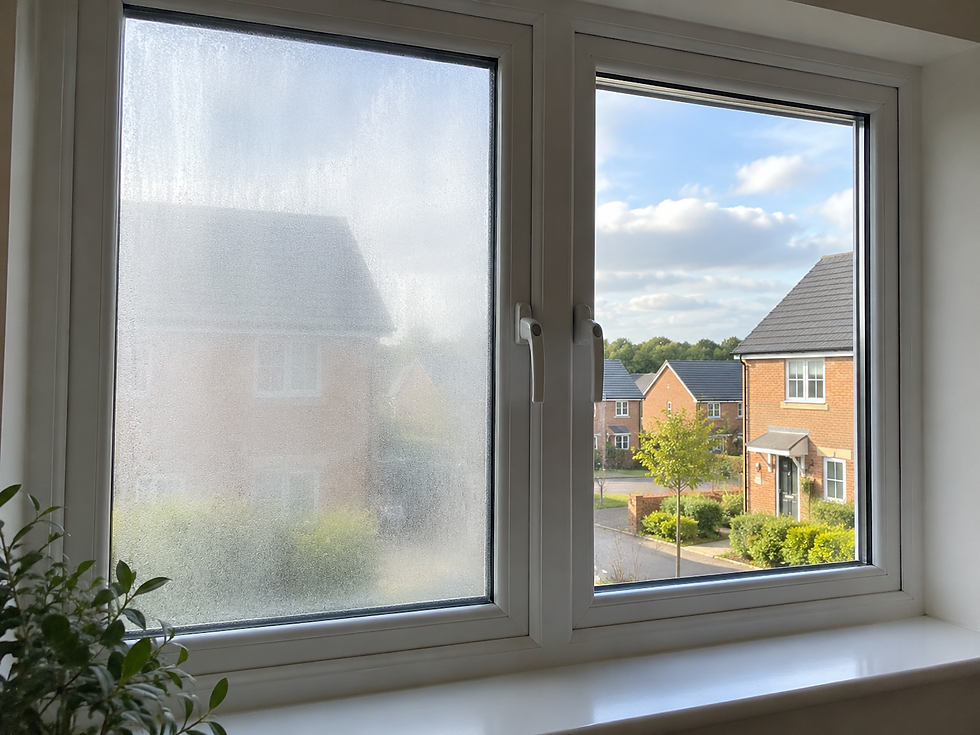
Condensation on the windows of a new-build home can mean very different things depending on where the moisture is.
It might be:
on the inside surface of the window;
on the outside surface;
or trapped between the panes of glass.
Those three situations have different causes — and only one usually points directly towards a problem with the sealed glazing unit itself.
Quick answer: where is the condensation?
Where is it? | What does it usually mean? |
Inside the room | Humid indoor air is condensing against the colder glass |
Outside the window | Often a normal effect of thermally efficient glazing |
Between the panes | Usually indicates failure of the sealed double-glazed unit |
So before reporting condensation as a snag, work out which surface it is actually on.

Why does condensation form on windows?
Air naturally contains water vapour.
Warm air can hold more moisture than cold air. When warm, humid air reaches a sufficiently cold surface, it cools and can no longer hold all of that moisture.
Some of the water vapour then becomes liquid droplets.
Windows commonly show this first because the glass can be one of the colder surfaces in a room.
New-build homes have another factor to consider: construction moisture.
Materials including plaster, mortar, screeds and concrete contain water when the home is built. Some of that moisture gradually evaporates into the home as the building dries.
Current NHBC homeowner guidance says a newly built home can take around 18 months to two years to reach a moisture-balanced state, although conditions and construction will vary.
This is one reason condensation can be more noticeable during the early life of a new home.
But “it's a new-build drying out” shouldn't automatically be used to dismiss every persistent damp or condensation problem.
What does condensation on the inside of the window mean?
If you can wipe the moisture away from inside the room, you are dealing with internal surface condensation.
This usually means there is more moisture in the indoor air than can comfortably remain there when it meets the colder glass.
Everyday activities contribute moisture, including:
showering;
cooking;
drying clothes;
and simply breathing.
Construction moisture can add to this in a recently completed home.
What should you do?
Start with the ventilation that was designed into the property.
That might mean:
keeping trickle vents open;
using bathroom extract fans while showering;
using the kitchen extraction provided;
operating continuous mechanical ventilation correctly;
or using the boost setting on an MVHR or mechanical extract system when appropriate.
NHBC specifically recommends keeping trickle vents open, using extract ventilation and heating new homes consistently while they dry.
Don't automatically switch off an extractor or continuous ventilation system because it seems to run unnecessarily. Modern homes are relatively airtight, so their ventilation strategy matters.
Is condensation inside a new-build window a snag?
Not automatically.
Occasional morning condensation during cold weather can occur without there being anything wrong with the window.
However, there is a difference between a little temporary moisture and a persistent problem.
It is worth looking more closely if:
windows are heavily wet every day;
water regularly collects on the sill;
mould is developing around reveals or frames;
condensation continues despite using the ventilation correctly;
one room or window is dramatically worse than everywhere else;
or nearby walls also appear damp.
Persistent condensation can relate to excessive humidity, insufficient ventilation or unusually cold surfaces. NHBC also notes that cold bridging combined with inadequate ventilation can contribute to condensation and mould.
In that situation, simply wiping the glass every morning deals with the symptom rather than establishing why it keeps happening.
What does condensation on the outside of double glazing mean?
This one surprises homeowners.
If condensation appears on the outside of the external pane, it can actually be a consequence of having thermally efficient glazing.
Modern low-emissivity double and triple glazing is designed to keep heat inside your home.
Because less indoor heat reaches the outer pane, that pane can remain colder. Under the right combination of outdoor temperature and humidity, moisture from the outside air can then condense onto it.
The Glass and Glazing Federation describes external condensation as a consequence of efficient glazing reducing heat transfer through the window. It is particularly associated with certain cool, humid conditions.
It may appear:
early in the morning;
during spring or autumn;
on only certain windows;
or even on one pane but not the one beside it.
Orientation, nearby buildings, vegetation, wind and local conditions can all affect which glass becomes cold enough for condensation to form. Pilkington
Is external condensation a snag?
Generally, no.
If the water is genuinely on the exterior surface and disappears as conditions change, it doesn't normally indicate a failed window.
You usually don't need to do anything.
What if the condensation is between the panes?
This is the one to pay attention to.
Modern double glazing uses a sealed insulating glass unit (IGU) — also commonly called a double-glazed unit (DGU).
The two panes of glass are separated by a spacer bar, with the cavity between them sealed around the edges. That cavity may contain dry air or an insulating gas such as argon, and the spacer usually contains a desiccant to absorb small amounts of residual moisture. Pilkington
If the edge seal fails, outside air and moisture can gradually enter the cavity.
Once enough moisture gets in, you may see:
misting;
condensation;
a cloudy appearance;
or droplets that cannot be wiped from either side of the glass.
That is commonly referred to as a failed sealed unit or blown DGU.
Pilkington advises that misting between the panes indicates seal failure and that the glass unit should be replaced. Pilkington
Does a failed DGU affect the window's performance?
Potentially, yes.
The sealed cavity is part of what gives modern double glazing its thermal performance. If the seal fails, insulating gas can gradually escape and moist air can enter the cavity.
That means the unit may no longer perform exactly as it was designed to. Gas such as argon is used specifically to improve the thermal resistance of the glazing, so losing that sealed environment can reduce performance.
The most obvious sign to the homeowner is usually the misting rather than a dramatic overnight change in room temperature, but it is still a genuine failure of the sealed glass unit.
Can a misted DGU be repaired?
You may come across services offering to “defog” or “demist” failed double glazing.
These can sometimes improve the appearance by removing moisture, but they do not recreate the original factory-sealed unit, replace lost insulating gas or restore the failed edge seal to its original specification.
For a failed sealed unit in a relatively new home, the normal proper remedy is therefore replacement of the DGU itself.
That does not usually mean replacing the entire window.
If the frame, hinges and other components are sound, the glazing unit can normally be measured, manufactured to size and replaced within the existing frame. The Glass and Glazing Federation describes sealed-unit replacement as the normal remedy where condensation has appeared between panes because the unit seal has failed.
Is it a snag?
On a relatively new home, I would report it.
Take a photograph while the misting is clearly visible and report it through the developer's normal aftercare route.
A useful description would be:
Misting visible between panes of double-glazed unit. Moisture cannot be wiped from internal or external surface. Please inspect for sealed-unit failure.
That's much clearer than simply reporting “condensation on window.”

How can I tell which side the condensation is on?
The easiest test is simple:
Try to wipe it.
If it wipes from inside the room, it's internal condensation.
If you can't wipe it but it disappears when the weather warms outside, it may be exterior condensation.
If the glass looks misty and the moisture cannot be reached from either side, it is likely within the sealed unit.
Take photographs while it is clearly visible. Intermittent problems have a habit of disappearing just before somebody arrives to inspect them.
What should I record before reporting it?
If you're concerned, don't just photograph a close-up of some water droplets.
Record:
which window and room it is;
whether the moisture is inside, outside or between the panes;
when it normally appears;
a wider photograph showing the whole window;
and a closer photograph showing the condensation clearly.
If internal condensation is persistent, it's also worth noting whether vents are open and whether the room's extraction or ventilation appears to be operating normally.
That gives the developer much more useful information than simply saying “the window keeps getting condensation.”
Record it with The SnagClear App
The SnagClear App lets you photograph an issue, record its location and description, keep it with the rest of your new-build snags and include it in a clear PDF report to your developer.
For intermittent issues such as condensation or misting, having a dated photographic record can be particularly useful.
When should I be concerned about condensation on new-build windows?
The simplest rule is to ask where the moisture is and whether it keeps coming back.
Inside the window
Occasional condensation can be normal, particularly while a new home is drying. Persistent heavy condensation, mould or damp deserves further attention.
Outside the window
Usually nothing to worry about. It can actually occur because modern glazing is doing a good job of keeping heat inside.
Between the panes
Report it. Persistent misting inside a sealed double-glazed unit usually points towards a failed seal rather than ordinary household condensation.
So before assuming your new-build window is defective, perform one very simple check:
Inside, outside or between?
That usually tells you what to do next.


Comments