Can You Board a New-Build Loft for Storage? What Homeowners Should Check First
A new-build loft can look like a huge amount of wasted storage space, especially when you have just moved in and still have boxes everywhere.
But before laying boards across the roof space, it is worth understanding what the loft was actually designed to do.
In many homes, creating some loft storage is possible. The important point is that boarding should not squash the insulation, obstruct ventilation, make services inaccessible or place loads on the roof structure that it was not designed to carry.
And if your developer has already installed a small boarded area or walkway, don't automatically assume the whole loft is intended for storage. It may simply have been provided for access to plant or other services.

Can you board a new-build loft?
Potentially, yes. But “Can I fit boards?” and “Was this loft designed to be used as a storage floor?” are not quite the same question.
Many new-build homes have a cold roof, with insulation laid at ceiling level and the roof space above sitting outside the heated part of the home.
Deep mineral-wool insulation will often extend above the ceiling joists or bottom chords of roof trusses.
The structure matters too. A typical roof space may accommodate access and some light storage when appropriately designed, but you shouldn't assume it can carry unlimited boxes, furniture or other heavy items simply because boarding can physically be fitted.
If your home uses engineered roof trusses, don't cut, notch or alter structural members to make boarding fit. The trusses work together as a structural system.
If you are uncertain about the loading capacity, ask the developer, truss designer or a suitably competent professional before creating a substantial storage deck.
Why shouldn't you put loft boards directly on top of insulation?
Because compressing insulation can reduce its thermal performance.
Mineral-wool insulation works by trapping air within its fibres. Squashing it beneath boards reduces its thickness and can make it less effective.
Energy Saving Trust specifically advises against compressing mineral wool and recommends raising the floor where storage is required so the insulation can remain at its intended depth. It currently recommends around 270mm of mineral wool as a benchmark for loft insulation, although the required thickness depends on the insulation product and the home's construction.
Modern insulation can therefore be considerably deeper than the ceiling timbers beneath it.
Simply placing chipboard across the joists may mean either:
squashing the insulation; or
removing some of it to make the boards fit.
Neither should be the default solution just to gain some extra storage.
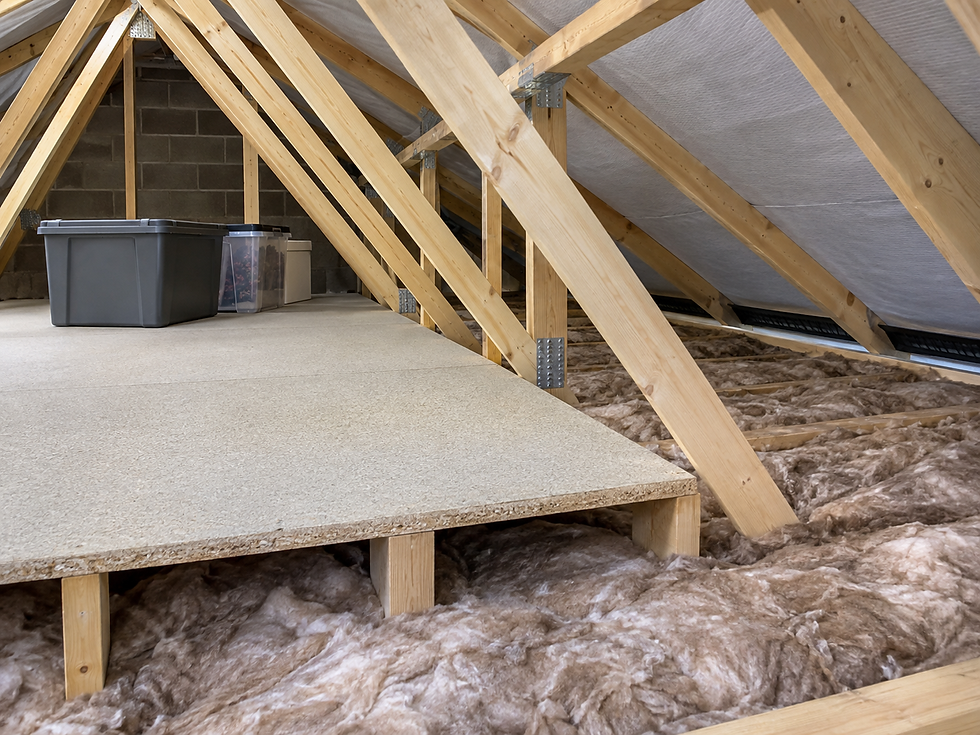
If the insulation needs to remain at full depth, the storage deck generally needs to sit above it.

What are loft boarding pedestals or raised systems?
One solution is a raised loft boarding system.
These use proprietary supports, often described as loft legs, pedestals or stilts, to support the boards above the insulation.
Used appropriately, they can:
maintain the intended insulation depth;
create a defined walking and storage surface;
reduce the temptation to step between concealed timbers;
keep stored items away from the insulation.
However, raised supports don't magically increase the strength of the structure beneath them.
The boards, pedestals and everything stored on top still add load.
Follow the system manufacturer's installation and loading instructions and consider how much boarding you genuinely need.
A smaller platform for lightweight storage may make more sense than automatically boarding the entire loft.
Why is part of my new-build loft already boarded?
It might not be there for storage at all.
Some new homes have equipment in the loft such as:
MVHR units;
ventilation equipment;
valves;
heating equipment;
other building services.
Where equipment requires maintenance, access needs to be provided. Current Approved Document F guidance in England requires reasonable access for maintaining ventilation systems, including filters, fans, ducts and plant.
That can explain a narrow boarded route from the loft hatch to a piece of equipment or a small platform around it.
A maintenance walkway shouldn't automatically be treated as a storage deck.
Filling it with boxes can make future servicing more difficult and defeat the reason it was provided in the first place.

What are the advantages of boarding a loft?
More usable storage
The obvious advantage is space.
Suitcases, Christmas decorations and other lightweight belongings can be moved out of cupboards and spare bedrooms.
Safer occasional access
A properly designed boarded route also makes it easier to move through the loft without trying to balance on concealed timbers.
Once deep insulation covers the ceiling structure, it may be difficult to see where it is safe to place your feet.
Easier access to equipment
Where plant or services are installed in the loft, suitable boarding can make future inspection and servicing much easier.
Less disturbance to insulation
With a raised platform, belongings stay away from the insulation instead of repeatedly flattening or moving it whenever something is retrieved.
What are the disadvantages of loft boarding?
It can make insulation maintenance, replacement or upgrades harder
Loft insulation doesn't automatically need replacing simply because it gets older.
Energy Saving Trust says correctly installed loft insulation can have a lifespan of around 40 years. However, it can become compressed, displaced, damaged by pests, contaminated or affected by water ingress. Existing insulation may also eventually need topping up as part of future energy-efficiency work.
A large boarded deck makes this work more awkward because the stored items, boards and potentially the raised supports need to be removed first.
So think beyond today's storage needs.
Leaving areas accessible can make future inspection, maintenance and insulation work much easier.
Using the loft can sometimes lead to ceiling cracks below
Walking through and loading a loft introduces additional loads and small amounts of movement into the supporting structure.
In some homes, that movement can contribute to hairline cracking at plasterboard joints or ceiling finishes below.
That does not necessarily indicate a structural defect. Small cracks may simply result in some filling and redecoration.
But it is another reason to use designated boarding, avoid unnecessary loading and never place your weight directly onto the plasterboard ceiling between the structural supports.
Sudden or significant cracking, obvious sagging or cracks that continue to worsen deserve a different level of attention and should be investigated.
It can make services harder to reach
Electrical cables, pipework and other services often run through the roof space.
Extensive boarding can make future repairs, leak investigations or alterations harder.
Avoid permanently covering anything that may need inspection or maintenance.
It adds weight
The boards have weight. The supports have weight. Then the storage gradually accumulates.
A few boxes of decorations are very different from books, furniture, building materials or other dense items.
Don't treat a boarded cold loft like an additional habitable floor unless it has actually been designed for that purpose.
It can interfere with airflow/ventilation
Loft ventilation must continue to work as intended.
Energy Saving Trust advises against obstructing intentional ventilation when insulating a loft, while NHBC guidance notes that storing belongings in a roof space can restrict airflow.
This is particularly important around eaves and other ventilation openings.
Packing belongings into every available corner just to maximise storage isn't necessarily a good idea.
Can loft storage cause condensation?
Storage itself doesn't automatically create condensation.
However, it can contribute to conditions that make moisture problems worse if it restricts airflow, disturbs insulation or hides an existing issue.
Cold lofts are designed to manage moisture in a particular way. Depending on the roof design, this may involve ventilation openings and/or vapour-permeable roof underlays.
NHBC notes that condensation can occur in roof spaces, particularly during colder weather, and that ventilation or breathability helps moisture disperse.
If you are already seeing persistent heavy condensation, damp insulation, mould, staining or signs of water ingress, investigate that before covering large areas with boarding or filling the loft with belongings.
Could boarding my loft affect my new-build warranty?
Don't assume that boarding the loft automatically invalidates your entire new-build warranty.
Equally, don't assume that damage caused by alterations you make afterwards will be covered.
For example, NHBC states that Buildmark does not cover alterations, modifications or additions to the home, or problems caused by those works. Other warranty providers may have different terms.
Before extensive loft boarding, check:
your own warranty documents;
your developer's homeowner guidance;
the proposed system's instructions;
whether any specific restrictions apply to your home.
Keeping photographs of the loft before and after the work is sensible too.
What should you check before boarding a new-build loft?
Before ordering the boards, ask:
What type and depth of insulation is already installed?
Will the boarding leave that insulation uncompressed?
Are there ventilation routes that must remain clear?
Is existing boarding actually just a maintenance walkway?
Is there equipment that requires permanent access?
Is the structure suitable for the intended boarding and storage load?
Will cables, pipes and other services remain accessible?
What do your developer and warranty documents say about alterations?
Do you genuinely need to board the whole loft?
If you cannot confidently answer the structural, ventilation or servicing questions, getting competent advice before starting is considerably easier than correcting a problem afterwards.
Quick questions about new-build loft boarding
Can I put boards directly over loft insulation?
Not if the boards will compress the insulation. Mineral wool should generally remain at its intended thickness. Where storage is appropriate, a raised system may provide a better solution.
Can I walk on loft insulation?
No. Insulation is not a walking surface, and the plasterboard ceiling beneath it isn't intended to take your weight. Use appropriate boarding or structural supports and take particular care where insulation hides the timbers.
Does loft boarding invalidate my new-build warranty?
Not automatically. However, your warranty may exclude the alterations themselves and any damage they cause. Always check your own policy rather than relying on a general rule.
Why has my developer only boarded a narrow strip?
It may have been installed as a maintenance route to plant or other services rather than as storage. Keep those routes clear unless your handover information confirms otherwise.
The bottom line
Loft boarding can be a genuinely useful addition to a new-build home — but simply laying chipboard over the insulation isn't the answer.
A sensible installation preserves the insulation depth, keeps ventilation routes clear, maintains access to services and considers the loads being applied to the roof structure.
It should also consider the future. Insulation may eventually need inspection, repositioning, topping up or replacement, and extensive boarding can make all of that more difficult.
If you're inspecting your new home, the SnagClear App can help you photograph and record issues such as disturbed insulation, damaged boarding, poor loft access or other snags and include them in a clear PDF report.
For more practical advice throughout the new-build journey, visit the SnagClear Hub.


Comments